Gran Gets the Message
The theme for this month’s short story is ‘getting the message.’ It is to be hoped that Gran does indeed get the message, and starts to allow her grandson to follow his heart. Inter-generational living isn’t always all it’s cracked up to be, especially when one member of the household appears to be living in a previous century.
‘George! What do you think you’re doing?’
George looked up as Gran called to him.
‘It’s my homework, Gran.’
‘Homework? What do you need with homework? It’s Saturday.’ Gran tied to peer over George’s shoulder, but couldn’t make head nor tail of the hieroglyphics on his paper. ‘You should be out and about – playing football. You like football, don’t you?’
George shrugged. He wasn’t that bothered. He could kick a ball all right; he could score a goal. Mr Phillips, the games teacher, said if he practised, he could get on the team. But, really? All that shouting, the pretending to be hurt if someone so much as touched you? Behaviour that didn’t seem to change, even when Mr Phillips made it clear he took a very dim view of this ‘acting up.’ At the last match, he sent Barney Smith off for trying to get his own cousin (who just happened to be playing for the opposing team) red-carded. Given it was obvious to all the spectators that Barney had not been touched, but deliberately tripped over his own feet, there was very little sympathy – except from Barney’s particular cronies on the team. But none of them were brave enough to argue with Mr Phillips.
The Headmaster didn’t have any choice about getting involved when Barney’s dad came into school the next day to demand Mr Phillips was sacked ‘this instant.’ They all heard the row. Well, the year 6s did. Given they were supposed to be having a history lesson with the Head at the time, it was difficult not to hear Mr Smith’s shouting when the ‘conversation’ went on in the corridor. Mr Smith, pursued by the school secretary, had pounded down that very same corridor: ‘I don’t care what he’s doing. He’s talking to me – NOW!’
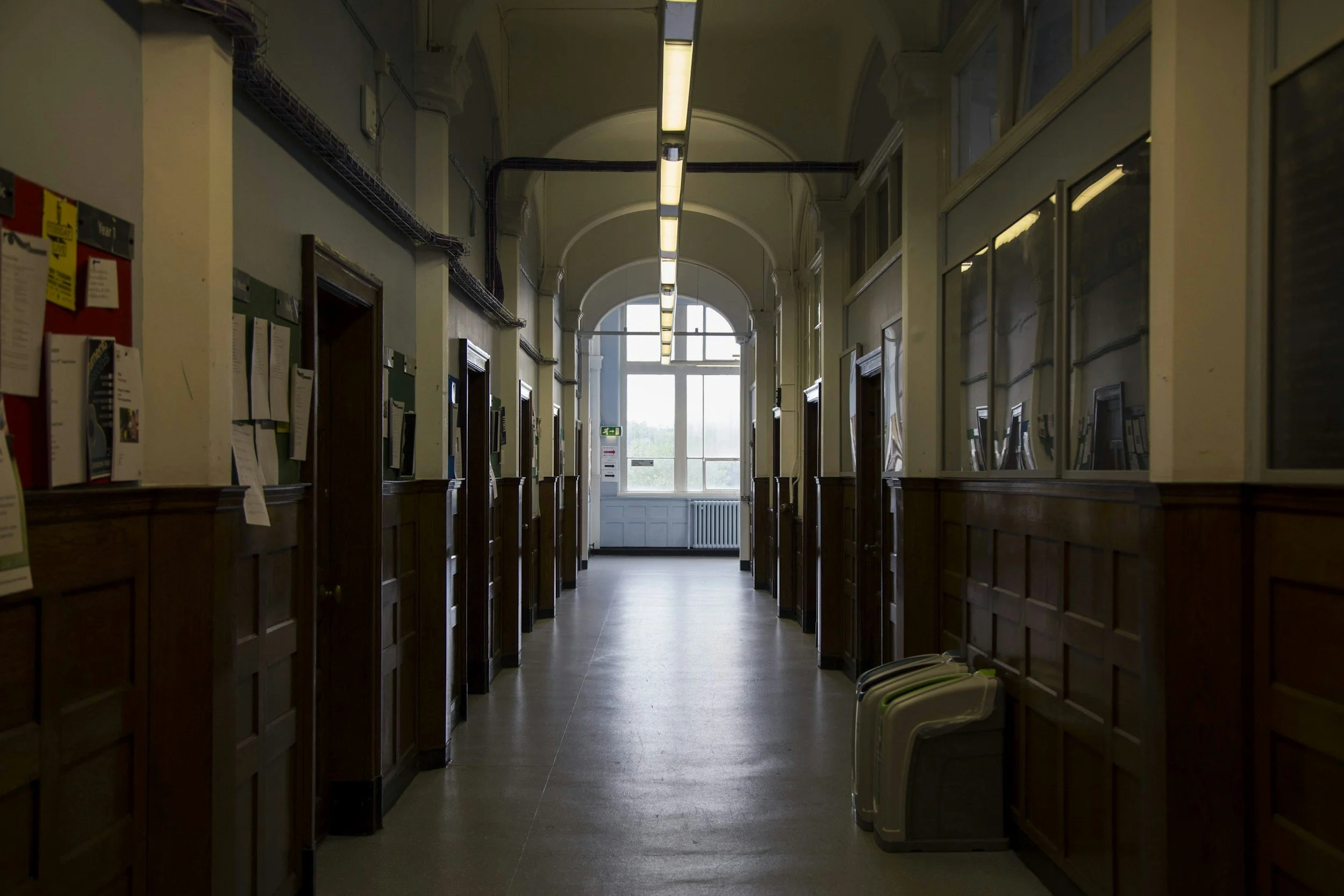
All the Head could do was set the class some reading, and leave them to it. He did close the door behind him, and try to lead Mr Smith away.
‘No. I’m not going to your bloody office! You can’t tell me what to do.’
‘Then what makes you think you can tell me what to do with my staff?’
‘You’ll get rid of that stupid excuse for a games master! He’s biased against my son. And I’ll not have it.’ And so on and so forth. Plenty of words George would get into trouble over if he repeated them at home. In the end, Barney’s dad said either the teacher goes, or ‘the best football player you’ve had for years’ goes. George was not sure Barney’s dad was expecting the head to offer to let him take his son ‘straightaway.’
The Headmaster suited his actions to the words. He opened the classroom door (which he must have known wasn’t soundproof), and called to Barney – who, having realised his dad was having no success in bullying the Headmaster, had spent the last ten minutes trying to hide himself behind his desk – ‘Barney? There you are. I think your father is taking you home. I do hope he has another school lined up for you. Come on, now.’
Then, from behind the re-closed door. ‘There are procedures to follow. I will be getting in touch with all the appropriate authorities, or my secretary will, as soon as I have finished teaching.’ This time, the voices did fade away, and Barney was ‘signed out’ for the rest of the day.
Needless to say, any information the Head was trying to get across about King Henry VIII that lesson, was not retained by any of his students.
Once it became clear Barney was not coming back to their school, George was happy. What surprised him was how many of the keen football players were also happy. No doubt plenty of those keen players would be turning up at football practice this morning, trying out for the team. But George was content to sit at the French windows of his new home, looking out at the garden, and filling in the form for Miss Vaughan, the Humanities teacher.
The sheet came from the RSPB spring bird-watch. As a homework, it was voluntary, and, on Monday, a lot of the boys would shrug, claim they ‘didn’t have time, Miss,’ and get on with discussing last weekend’s football results, but Miss Vaughan wanted to compare any results they got with results their parents might have got twenty-five years ago, to see what had changed. George wanted to see what had changed, too.
What hadn’t changed, was Gran’s idea that all boys should like running around, kicking a ball. Unlike at his old home, of course, everyone here was a ‘Baggie.’ George, when he first arrived at school, had thought he’d been safe by saying ‘Manchester United’ when he was asked the inevitable question.
‘Who? They’re useless.’
George, still upset about his move, and the reason why he had to come to this school, had wandered away. There were other things to do than play football. If he had to do games (which they did, once a week), then he preferred tennis, or badminton – but what he really liked was running. Long distance running. Not that they would ever be allowed to do that from school. What if something happened while the boys and girls were out of school grounds? The repercussions would be horrendous. At least that’s how Mum put it when George asked her why he couldn’t do running at school. He could remember when Dad had been training for his half-marathons. In the early stages, when Dad was only doing shorter distances, George had been allowed to go out with him. When he was old enough, he wanted to do his own half-marathon in Dad’s memory.
George bent his head over his work and tried to ignore Gran. Mum said she meant well, but Gran’s ideas were so twentieth-century. Like now: George was a boy, boys like football, so why wasn’t George outside, doing just that?
‘Come on! You can’t stay inside all day. You can leave that.’
‘No, I can’t! I’ve got to do this for an hour.’
But Gran was leaning over and trying to grab his paper from him. ‘There’s a match on at your school’s games field in twenty minutes. I’ve said you’ll play.’
‘What have you done now, Mum?’ George’s mum had just arrived back, with all the shopping. She’d been to do that early, as she, unlike Gran, supported George’s idea about the half-marathon. However, Mum said George would have to build up to it: like Dad had done. Today, once everything was organised, Mum was going to take him out for a run. She said she needed to get fit too, and it was – well, it was a good, practical way to remember Dad.
‘He’s a boy! He needs to outside – playing football. They’re expecting him.’
‘Without asking him – or me? I’m his mother.’
‘You molly-coddle him.’
‘Mum,’ said George’s mum in her no-nonsense voice, ‘A word. Now.’ She led Gran out of the dining room. They went into the kitchen. George didn’t bother following them. He knew he’d be able to hear everything, even if they started quietly. As he expected, after a couple of minutes, they were making so much noise all the birds flew away. Quite what he’d say to Miss Vaughan about that, he wasn’t sure.
‘I lost my husband. Which means George has lost his father –’ That was Mum.
‘Over a year ago. When I lost my husband, I just had to carry on, none of this counselling rubbish.’ Gran’s counter-thrust.
‘Maybe you should get some therapy. It might help.’
George hadn’t heard Gran snort before, but the sound she made now could only be described as a snort – it reminded him of when they went to that farm as a family and the horse snorted and its snot went all over Dad’s shirt. At the time, it was so funny! Mum had to use all her tissues trying to get Dad clean. George tried to clear the lump in his throat.
The conversation, or argument, was still going on with Mum yet again trying to update Gran on life in the twenty-first century.
‘They have a girls’ team at George’s school as well. And don’t say girls don’t play football – they do these days. Some girls like football. And some boys don’t.’
‘I’m not raising a wimp for a grandson!’
‘How dare you! He’s not a wimp. And I’m the one raising him – not you.’
‘While you’re living in my home, I make the decisions.’
‘It’s not your home. It’s our home. You can go back to the damp property you shared with Dad if you like.’
George smiled, not just because he was glad he had someone on his side. Grandad had gone off to live in Spain with a woman he met at work. Gran called her a ‘floozy’ who was ‘half his age.’ Anyway, Gran was on her own, saying she couldn’t afford to pay all Grandad’s debts, and they could only be paid off if she sold her house. Mum had to sell their home too, because after Dad died, the insurance didn’t quite cover all the costs – George remembered Mum having to explain it all to him. He’d wanted to stay in the same house Dad had lived in. He didn’t want to move in with Gran, but Mum had thought it was the best as it meant Gran could be at home when George came in from his new school on the days when Mum was at work.
This arrangement wasn’t working as well as Mum hoped. Mum had already ‘had a word’ with Gran, saying that if George came home with homework, he was to be encouraged to do it – not told to leave it: whatever the attitude of George’s previous school, this school, this prep school, expected homework to be completed. Mum was also not happy if Gran was trying to make George do something he didn’t want to do, ‘for his own good.’ Gran’s response was to say he needed to get used to ‘life’s hard knocks.’ ‘If you don’t get up after being knocked down, you’ll stay down forever, waiting for people to tread all over you.’
‘Mum, what does that even mean?’ Mum said, ‘George is ten for God’s sake.’
‘Yes! Plenty old enough not to be hanging onto his mother’s apron strings. There’ll be men at the football match. They’ve got a wonderful coach. That games master seems to know what he’s doing. Really brings the lads on.’

‘I don’t care. I promised him I’d go out with him for a run. I told you we’re going to train for the Parkrun five “K,” and I need to be fit enough to keep up with him. So, he doesn’t need to be exhausted from playing football for the rest of the morning.’
‘You’re taking him running? Five kilometres? After it killed Derek?’
‘Running didn’t kill Derek. What killed Derek was leukaemia. Being fit helped keep him going for as long as he did.’ Mum paused, but not for long. The volume dropped, but George could still hear every word Mum hissed to Gran, ‘And I’ll thank you, not to use Derek as a stick to try to beat me or my son over the head, just because you won’t get the message life is not like how it was when you were a girl, nor even when you got married.’
Another snort from Gran – but no more words. However, George’s mum hadn’t finished: ‘Right, Mum. I suggest you go over and tell them George won’t be coming to play football – because he’s training to run a five “K” in memory of his father. Not because he’s a wimp.’
‘I never said he’s a wimp.’
‘“I’m not raising a wimp for a grandson.”’ Mum paused. Gran failed to fill the silence. So, Mum filled it instead, ‘Mum. It’s going to stop. I’m not having him bullied. Not by classmates at school, not by you, not by teachers. You understand me?’
Three months later.
It had been tough. His legs burned. His chest hurt, but the finish line was in sight. George told himself, yet again, he was doing these five whole kilometres for his dad. Every muscle screamed at him to stop. But Mum was beside him, as she had said she would be.
‘Come on, George!’ was that Dad’s voice? George picked up his pace. He must get to that finish line. What had Mum said? You can always collapse afterwards.
‘Come on, George! You’re doing great!’ The line was closer, closer, and then he crossed it. And he was surrounded. Mum was hugging him. Gran was somewhere in the background, but another person was there, with a huge smile on his face, even putting George’s medal round his neck for him:
‘Well done, lad,’ a beaming Mr Phillips grabbed his shoulder, ‘I’m so proud of you!’

And then, after a delay because Gran ‘needed to have a word’ with Mr Phillips, the three of them went home. Burgers and chips with loads of tomato ketchup. And he didn’t even have to have any peas with it. His favourite, and cooked by Gran! She and Mum were sharing a bottle of wine, while he had a Coke – another treat.
‘Before I bring in the pudding,’ Gran said. George looked up. What now? Trust Gran to spoil it. But Mum was sort of half-smiling and nodding at her. Gran’s mouth twitched as she tried to smile back, and glanced at George. ‘I just want to say this to you, George.’ She paused, fiddled with the stem of her wine-glass. ‘I was wrong. I watched you today put your heart and soul into that race. Even your P.E. teacher seems to think you did very well. In fact, he told me …’ Gran swallowed, ‘He told me it’s not his job “to turn out reluctant footballers,” but help every boy and girl he teaches find a sport, any sport, they like. And, if yours is running: you should run.
‘So, George. You carry on running, for your dad, or for whoever. I’m sure he’s proud of you. Just as your mum is. And so am I.’ She finished in a rush, said, ‘The pudding won’t walk in here by itself.’ And disappeared towards the kitchen.
Given it was ice-cream with chocolate sauce, Gran took a long time to bring it in. George sat in silence. Stunned. But Mum stood up, walked round the table, held out her arms towards him. So, George also got down from the table, and the two of them shared a hug.
‘I’ll always be proud of you, George,’ Mum said, ‘And, you know, when Gran said she was proud of you, I really think she meant it.’